A planet of extremes.
Rust-colored plains are only the beginning. The landscape of Mars holds a remarkable record of volcanoes, impacts, ice, and flowing water.
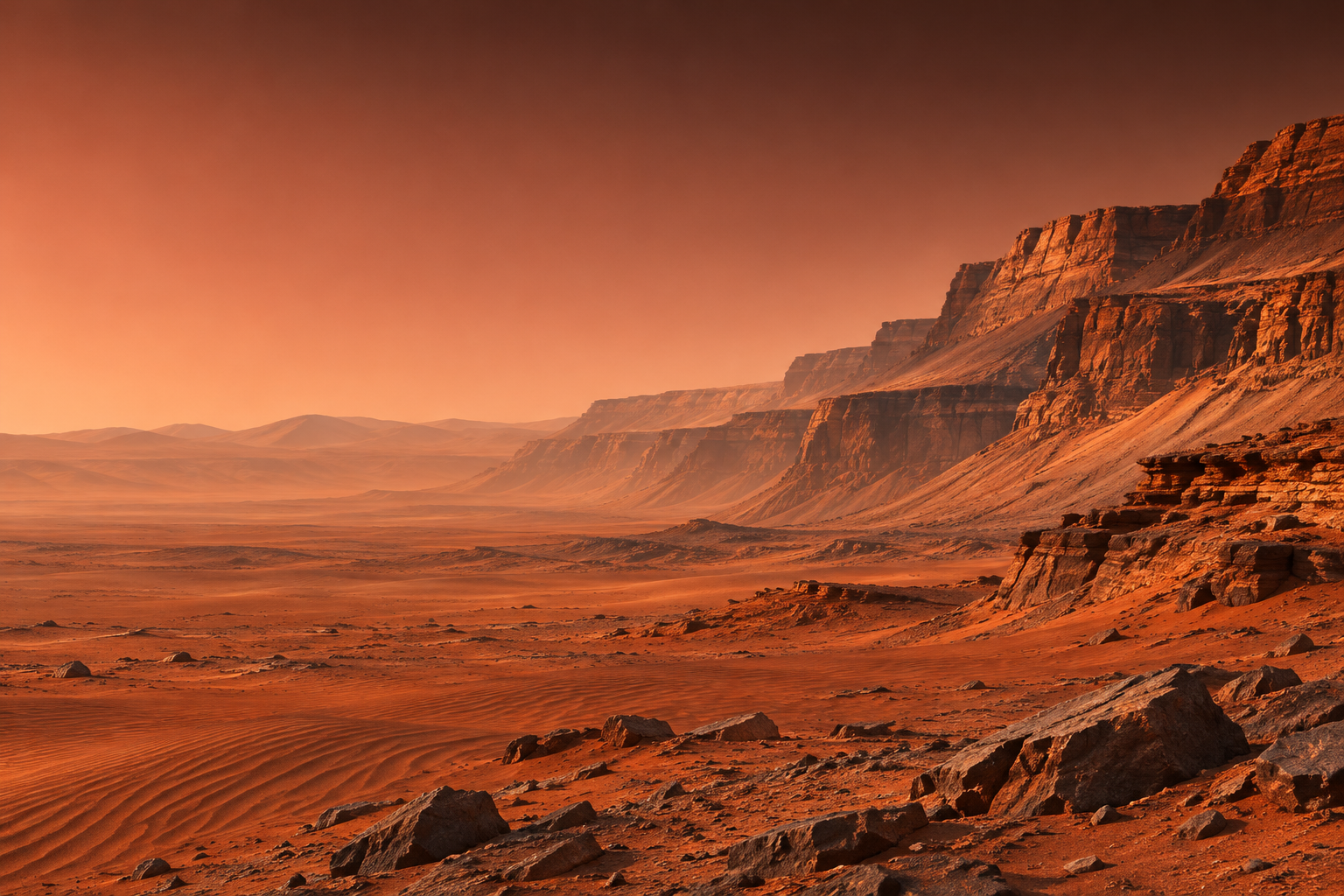
Artist’s impression of Martian terrain; not a photograph or a map of a specific location.
Reading the landscape
Iron minerals that have oxidized give Mars its familiar rusty color. Its surface includes cratered terrain, volcanic plains, dunes, and deep valleys.
Olympus Mons
This enormous shield volcano is the largest volcano in the solar system. Its broad, gently sloping form was built by repeated lava flows.
Valles Marineris
This canyon system stretches more than 4,000 kilometers across Mars. Crustal stretching and later erosion helped shape its dramatic walls.
Polar worlds
Both poles contain water ice. Seasonal deposits of frozen carbon dioxide grow and retreat as the planet moves through its long year.
A landscape with a water story
Ancient channels, deltas, and lake sediments point to a wetter past. Today, much of the planet’s accessible water is frozen, including ice beneath the surface.
Past habitability is not evidence of past life. Scientists investigate whether ancient environments could have supported organisms, while the question of life on Mars remains open.
Jezero Crater’s ancient delta is central to Perseverance’s research. In Gale Crater, Curiosity studies rock layers that preserve changing environments.
Meet the explorers ↗Two tiny companions
Mars has two small, irregular moons: Phobos and Deimos. Their origins remain an active scientific question.
| Moon | Distance | Orbital period |
|---|---|---|
| Phobos | 9,378 km | About 7.7 hours |
| Deimos | 23,459 km | About 30.3 hours |
Explore the evidence
Science notes are based on the sources below. Content reviewed November 3, 2026; this site does not display live mission telemetry.